Summary:
You made a thoughtful choice when you selected aquamation. Now you’re holding the remains, and no one handed you a roadmap for what happens next. That’s the part most people aren’t prepared for — and it’s more common than you’d think. Roughly 25% of U.S. households currently have at least one set of cremated remains at home, often because the family simply didn’t know where to start.
This guide is meant to help you figure that out. We’ll walk through the main disposition options, explain what makes aquamation ashes different, and help you find the choice that actually feels right for your family in Nassau County.
What Can You Make With Cremated Ashes After Aquamation
The first thing worth knowing is that aquamation ashes are chemically identical to flame cremation ashes — both are composed primarily of calcium phosphate, the mineral structure of bone. Every disposition option available to conventional cremation families is equally available to you. Nothing is off the table.
What is different is the volume. Aquamation typically produces 20 to 32 percent more remains than flame cremation for the same individual. The ashes also tend to be whiter, finer, and softer — closer to a fine powder than the coarser, gray consistency most people associate with cremation.
If you’re planning to use an urn, make sure it holds at least 250 to 280 cubic inches, because a standard urn may not be large enough. That extra volume also opens up something worth considering: you don’t have to choose just one option. Many families divide the remains — some for scattering, some for a keepsake — so that multiple family members can hold onto something meaningful.
What Can You Turn Cremated Ashes Into: Keepsakes, Art, and Memorial Objects
The keepsake market for cremated remains has expanded considerably in recent years, and the options range from understated to extraordinary. Memorial jewelry is one of the most common choices — small amounts of ash are incorporated into pendants, rings, or bracelets, often set in resin or glass. It’s a way to keep the person close without a permanent installation anywhere.
Memorial glass art takes a similar approach but on a larger scale. A glass artist fuses a small portion of the ashes into handblown glass, creating a sculpture, paperweight, or decorative piece that holds real color and texture. Each piece is one of a kind, and only a small amount of ash is needed — which is one reason it pairs well with aquamation, where families often have more remains to work with.
Memorial diamonds are at the higher end of the spectrum. The carbon from cremated remains is extracted and subjected to extreme heat and pressure over several months to produce a lab-grown diamond. It’s a genuine stone — not a synthetic replica — and it can be set into jewelry or kept as a standalone piece.
Other options include memorial pottery, vinyl records pressed with a small amount of ash, tattoo ink made with cremated remains, and tree urns that use the remains to support the growth of a living tree. Each of these is a legitimate, meaningful choice. The right one depends on what the person you lost would have wanted, and what your family needs to feel connected to them going forward.
One honest note: most of these keepsake options involve some form of industrial process. If you chose aquamation specifically because of its gentleness and environmental profile, it’s worth asking whether the final step feels consistent with that choice. That’s not a reason to rule anything out — it’s just a question worth sitting with.
What Can I Put Ashes In: Urns, Containers, and Keeping Remains at Home
If you’re not ready to make a final disposition decision, keeping the remains at home is completely valid. There’s no legal deadline for disposition in New York, and many families hold ashes for months or even years before they feel ready.
The question of what to put them in during that time is more practical than it might seem. A traditional urn is the most common container — available in wood, ceramic, metal, stone, and biodegradable materials. As noted above, aquamation families should size up: plan for at least 250 to 280 cubic inches to ensure the container holds the full volume of remains.
If you’re eventually planning to scatter or bury, a biodegradable urn is worth considering from the start, since it’s designed to break down naturally when the time comes. Keepsake urns are smaller containers meant to hold a portion of the remains, often used when the family wants to divide ashes among multiple people or locations. These are particularly practical for aquamation families, given the larger volume of remains.
Some families skip the urn entirely and keep the remains in the temporary container provided by the cremation provider until they’re ready to decide. That’s fine too. There’s no single right answer here — what matters is that you have the space and time to make a decision that feels intentional, not rushed.
Scattering Aquamation Ashes at Sea: How It Works and Why Nassau County Families Choose It
For families who chose aquamation because of its connection to nature and water, ocean scattering is often the option that feels most complete. The process that began with water ends with water.
For Nassau County families, this option has a particular resonance. The South Shore is defined by its relationship to water — the Atlantic, the bays, the marshlands. Scattering at sea isn’t a distant gesture for people who live here; it’s a return to something familiar and real.
Scattering at sea is federally regulated under the Marine Protection, Research, and Sanctuaries Act. The EPA requires that scattering occur at least three nautical miles from shore, that no plastic materials be used, and that the responsible party notify the EPA within 30 days of the event. These aren’t complicated requirements, but they do need to be followed — and working with a provider who handles all of that on your behalf removes a significant burden during an already difficult time.

Is It Legal to Scatter Ashes in the Ocean Near Nassau County?
Yes — ocean scattering is legal in New York, and Nassau County’s South Shore location makes it genuinely accessible. New York State does not impose additional restrictions beyond the federal EPA rules, so the process is relatively straightforward for families in the area.
The relevant federal body is EPA Region 2, which covers New York. The three-nautical-mile rule applies to all ocean scattering in this region, which means scattering at the beach, in tidal pools, or in the Great South Bay is not permitted. You need to be in open ocean water, and you need a vessel that can get you there safely.
We operate out of Freeport, NY — specifically at 1 Anchorage Way, Slip A23 — which sits right on the South Shore of Nassau County with direct water access. Our vessel, the Seaspray, is Coast Guard-inspected and led by Master Captain Scott Schafer, who holds a U.S. Coast Guard Master Captain license.
Scattering ceremonies take place off the coast of Point Lookout, a landmark that Nassau County families will recognize — the western tip of Jones Beach Island, where the bay meets the open Atlantic. Families who want to return to that place, to stand at Jones Beach and look out at the water, have somewhere real to go.
We handle all EPA documentation and notification, so you don’t have to navigate the regulatory side of this on your own. That’s part of what we do.
Attended vs. Unattended Sea Scattering: Which Option Fits Your Family
One of the first practical questions families ask is whether everyone needs to be on the boat. The answer is no — and having both options matters more than people realize.
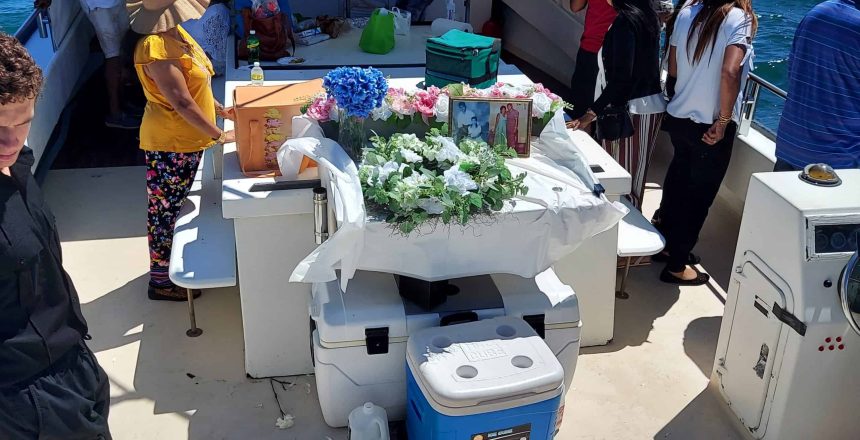
An attended ceremony means your family and guests join us aboard the Seaspray for the full journey. We travel at least three nautical miles offshore, and the ceremony takes place on the water. We can accommodate personalized music playlists, themed decorations, and religious or non-traditional ceremonies depending on what your family wants.
For Nassau County families with ties to the Catholic tradition, we offer the option of having a priest present to perform religious rites and prayers — something very few sea burial providers offer, and something that matters deeply to many families in this area given the presence of the Diocese of Rockville Centre. Pets are welcome aboard, too. If your loved one had an animal companion, there’s no reason that animal can’t be part of the farewell.
The Seaspray sits low in the water, which makes the ash release physically easy and accessible — an important detail for families with elderly members or anyone with limited mobility. We also operate year-round with a heated cabin, so a Nassau County winter doesn’t have to delay your plans or force a ceremony into a season that doesn’t feel right.
An unattended scattering is the option for families who are geographically spread out, or who simply prefer that Captain Schafer perform the scattering on their behalf without the family present. You receive documentation of where the scattering occurred, and you still have the peace of mind that the service was performed with care and in full compliance with federal regulations. It’s not a lesser option — for many families, it’s exactly what they need.
If you have questions about which approach fits your situation, our burial coordinator Maria Brusalis is the right person to speak with. She’s specifically dedicated to helping families navigate this process, and she’s a real point of contact — not a general inquiry line.
Choosing What to Do With Aquamation Ashes: Finding the Option That Fits Your Family
There’s no single right answer to what you do with water cremation ashes. Keepsakes are meaningful. Interment provides permanence. Scattering offers something different — a final resting place that isn’t static, that you can return to, and that for many families feels consistent with the values that led them to choose aquamation in the first place.
If ocean scattering feels like the right direction, the South Shore of Nassau County is one of the more naturally suited places in the country to do it. The water is part of life here. Point Lookout is a real place that real families know. And the logistics — the vessel, the captain, the coordinator, the paperwork — can all be handled without adding to your burden.
When you’re ready to talk through the options, Eternal Peace Sea Burials is here. Reach us at 631-668-5800 and ask for Maria — she’ll help you figure out what makes sense for your family, at whatever pace feels right.